Chapter 1
What Is the Glass Bead Game?
In 1943, Hermann Hesse published his final novel: The Glass Bead Game (Das Glasperlenspiel). It was the culmination of his life’s work, the book for which he received the Nobel Prize. And it describes something that does not exist.
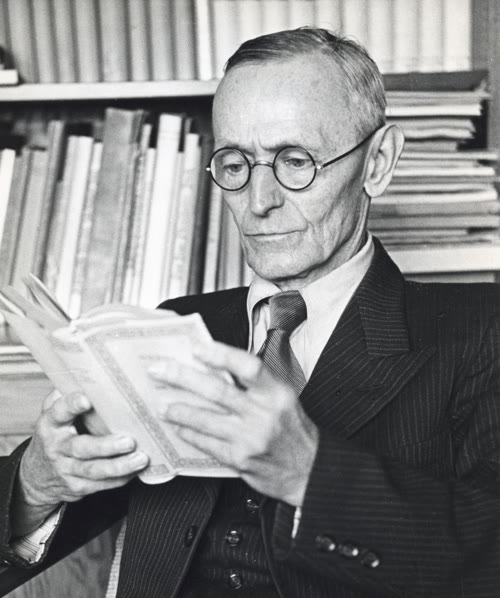
The Glass Bead Game is a fictional game played in the province of Castalia – a secluded intellectual community in an indeterminate future. The game connects all sciences and arts: music, mathematics, physics, philosophy, language. It has no fixed rules; rather, it is a practice of cross-connection. A player might link a Bach fugue with a differential equation, an astronomical constellation with a haiku, a chemical formula with an architectural motif.
Hesse describes it thus:
“The Glass Bead Game is [...] a game with all the contents and values of our culture; it plays with them as, say, in the great age of the arts a painter might have played with the colors on his palette.”
— Hermann Hesse, The Glass Bead Game (1943)
The protagonist Josef Knecht rises to become the Magister Ludi – the Master of the Game. He commands the connections between all disciplines like no one else. And then, at the height of his career, he does something unheard of: He leaves Castalia.
Why? Because he realizes that a game of pure synthesis, sealed off from the world, ultimately becomes empty. Knowledge must be lived. It is not enough to see the connections – one must be them.
Knecht’s departure is not a betrayal of Castalia. It is the logical consequence of everything Castalia taught him. Anyone who truly understands the connection between music and mathematics cannot remain in the ivory tower – because the connection does not exist in the tower; it exists in the sound of a string, in the breath of a child counting for the first time. Knecht’s lesson for us: every system of knowledge that cuts itself off from experience becomes an end in itself. And an end in itself that loses its connection to the world is merely a more elegant form of ignorance.
Already in Demian (1919), Hesse had prepared this insight:
“I wanted only to try to live in accord with the promptings which came from my true self. Why was that so very difficult?”
— Hermann Hesse, Demian (1919)
This blog post is a Glass Bead Game. It weaves together the threads of all previous posts – quantum physics, quantum computing, eigenvalues, the eigen-principle, deepfakes, emergence, God, Hopfield, Euler, music, logic – and adds a new thread: mindfulness. And in the end, like Knecht, it will reach its own limit.
What lies ahead: Where the same mathematics appears in different fields – and where the analogy ends (Chapter 2). The mathematics behind the commonality: \(e^{i\theta}\) (3). Emergence on three levels (4). Self-reference seen from the outside – with a pointer to the inner view in the sister piece “Dwelling in the Moment” (5). Gödel’s limit (6). Two personal experiences (7). Hesse’s path through four novels (8). At the end, this sentence describes itself.
Chapter 2
Where the Same Equation Appears – and Where It Does Not
Imagine an arrow that rotates. Nothing more: a length, a direction, a steady rotation. Mathematicians call it a complex number, \(e^{i\theta}\). The same tool appears in three fields that, at first glance, have nothing to do with each other.
Quantum Physics: The Arrow as Amplitude
In quantum physics, this arrow is an amplitude. Imagine every possible path of an electron carrying a tiny clock hand. This hand rotates during flight – fast for high-energy paths, slow for low-energy ones. At the destination, all the hands add up to a single arrow. That is Feynman’s path integral, written down in 1948.
What does “interference” mean in this picture? When two hands at the destination point in the same direction, their lengths add up – constructive interference. The result is a long arrow, meaning a high probability. When two hands point in opposite directions, they cancel out – destructive interference. The resulting arrow is short or zero; the probability vanishes. That is exactly how the stripe pattern at the double slit arises: at some positions, the arrows from the two paths align; at others, they oppose each other. No mysticism – just arrows adding up.
Music: The Arrow as Vibration
On a guitar string, the same \(e^{i\theta}\) describes a vibrational mode. But why do overtones arise in the first place? Because a string is fixed at both ends. Only vibrations that are zero at both anchor points “fit” on the string. Those are exactly the integer multiples of the fundamental frequency.
Concretely: a low A string vibrates at 110 Hz. That is the fundamental. But at the same time it also vibrates at 220 Hz (one octave higher), 330 Hz (a fifth above that), 440 Hz (another octave), 550 Hz, 660 Hz – and so on. These overtones are quieter, but they are all present simultaneously. Fourier showed in 1822: every sound is a superposition of such vibrations.
And consonance? Two notes sound “good together” when their overtone series share many common frequencies. A (110 Hz) and E (165 Hz) share the overtones 330, 660, 990 Hz – that is why the perfect fifth sounds pure. It is not aesthetics; it is arithmetic. But one does not exclude the other.
Artificial Intelligence: The Arrow as Eigenvector
In linear algebra, the arrow is called an eigenvector. What does that mean intuitively? Most vectors change direction when you multiply them by a matrix – they get rotated, compressed, distorted. But some special vectors keep their direction. Only their length changes. These “survivors” are the eigenvectors, and the factor by which their length changes is the eigenvalue.
That sounds abstract. But it is the foundation of half the internet: Google’s PageRank computes the dominant eigenvector of a huge link matrix – the web page whose “direction” no longer changes through repeated multiplication is the most relevant one. Kernel Ridge Regression, neural networks – they all solve eigenvalue problems. The KRR Chat shows that it works.
Where the Analogy Holds – and Where It Does Not
Up to this point, this is hard mathematics: in all three cases, \(e^{i\theta}\) appears, and the structure – eigenvalues, eigenfunctions, spectral decomposition – is identical. Not similar. Identical. The same equations, the same solution methods. Schrödinger titled his 1926 paper “Quantization as an Eigenvalue Problem,” and the title applies far beyond physics.
But I have to be honest: not everything that looks like an eigenvalue problem actually is one. In Gödel’s proof, there are fixed points that resemble eigenvectors – “Gödel’s fixed point reminds me of an eigenvector” is a metaphor, not an isomorphism. And “consciousness as an eigen-pattern” is speculation, not a theorem. Tononi’s Integrated Information Theory is a proposal, not a proven result. The difference between “is the same” and “reminds me of” is the difference between science and wishful thinking. The temptation to say “everything is connected to everything” is strong. I am trying to resist it.
What I can say: in quantum physics, music, and AI, the mathematical structure is not merely similar. It is the same. And that alone I find astonishing enough.
But there is one connection that is neither pure mathematics nor pure metaphor. In quantum mechanics, paths with random phases cancel each other out – only the coherent ones survive. That is why the classical world exists: the crazy zigzag paths cancel, and the straight path remains.
In God as an Emergent Phenomenon, we argue that coherence – the internal consistency of an entire worldview – is a selection principle. What contradicts itself erodes. What fits together persists.
The same form: what is incoherent cancels. What is coherent persists. In physics, this is a theorem (Feynman’s path integral). In philosophy, it is an observation. But the structure – destructive interference as a selection mechanism – appears in both. This may be the deepest cross-connection in this blog.
Addendum: Hopfield closes the loop
Since this chapter was written, a post has appeared that docks in exactly here: Hopfield Networks. In one place it turns the connection just described into real mathematics – not merely a shared form.
First layer – an identity. The coherence model in the God post minimizes an energy over a valuation matrix \(W\), has a Lyapunov function, and settles into plural attractors – and maximizing it is NP-hard. That is, symbol for symbol, a Hopfield network. “Psychic coherence” and the energy landscape of a Hopfield network are not similar; they are the same. Hopfield is the engine under the hood of the God model.
Second layer – the bridge to quantum mechanics. Modern Hopfield networks – and therefore the attention inside every Transformer – weight states by softmax, i.e. by Boltzmann: \(p \propto e^{-\beta E}\). Feynman’s path integral sums over paths with \(e^{iS/\hbar}\). The two expressions look related – and they literally are: via the Wick rotation (making time imaginary, \(t \to -i\tau\)), the oscillating \(e^{iS/\hbar}\) becomes the damped \(e^{-S_E/\hbar}\) – the partition function of statistical mechanics.
$$\underbrace{\sum_{\text{paths}} e^{\,iS/\hbar}}_{\text{quantum path integral}} \;\xrightarrow{\;t\,\to\,-i\tau\;}\; \underbrace{\sum_{\text{states}} e^{-\beta E}}_{\text{Boltzmann / Hopfield}}$$This lets the part I cautiously called “neither pure mathematics nor pure metaphor” be upgraded to a theorem on the physics side: “the incoherent cancels, the coherent remains” is the stationary phase in the path integral and the convergence to the energy ground state in a Hopfield network – the same calculation, once in real and once in imaginary time.
Third layer – and this one honestly stays an observation. That worldview coherence behaves like this energy minimization is an analogy, not a proof – and certainly not the claim that the mind is “quantum.” “Quantum coherence” (phase relationships between amplitudes) and “psychic coherence” (internal consistency) share only the word. What they really share is the mathematical form of the exponential weight – and that they demonstrably share.
Try it yourself
Click on a node to see which concepts connect it to other posts. The edge colors indicate the type of connection.
Three fields, one equation: In quantum physics, music, and AI, the mathematical structure is demonstrably the same. Beyond that, there are analogies – to logic, to consciousness – but analogies are not proofs. Taking seriously the line between “is the same” and “reminds me of” is part of the game.
Chapter 3
eiθ – What Rotating Arrows Really Are
In the last chapter, \(e^{i\theta}\) appeared in three different worlds. But what is it, actually? I want to explain it from scratch – because I believe one of the deepest insights in mathematics hides behind this little formula.
What Is a Complex Number?
Forget the word “imaginary.” It is a historical accident and misleading. A complex number is nothing more than a point in a plane. Instead of a single number line (1, 2, 3, ...) you have two axes: the real axis (left-right) and the imaginary axis (up-down). The number \(3 + 2i\) means: go 3 to the right and 2 up. That is all. Not imaginary, not mystical – simply two-dimensional.
What Does \(e^{i\theta}\) Mean?
Now it gets beautiful. The formula \(e^{i\theta}\) describes a rotation by the angle \(\theta\). Imagine a hand attached to the origin with a length of 1. The angle \(\theta\) tells you where it points. At \(\theta = 0\) it points right (the number 1). At \(\theta = \pi/2\) it points up (the number \(i\)). At \(\theta = \pi\) it points left (the number \(-1\)). As \(\theta\) grows steadily, the hand sweeps around the unit circle.
Euler proved in 1748 that this relationship is exact:
Set \(\theta = \pi\), and you get an equation that many mathematicians call the most beautiful in the world:
Five of the most important numbers in mathematics – \(e\), \(i\), \(\pi\), 1, and 0 – in a single equation. The base of the natural logarithm, the imaginary unit, the ratio of circumference to diameter, the multiplicative identity, and the additive identity. Connected by nothing but addition, multiplication, and exponentiation.
Why Rotation Matters
Why does \(e^{i\theta}\) appear everywhere? Because oscillation is rotation viewed from the side. Imagine a ball moving in a circle. Illuminate it from the side with a flashlight. The ball’s shadow moves back and forth – a sine wave. The sine wave is the shadow of a rotation. That is why \(e^{i\omega t}\) describes both at once: rotation and oscillation. Two sides of the same coin.
And that is precisely why \(e^{i\theta}\) appears in quantum physics, music, and AI. Because all three are, at their core, oscillation problems. An electron is a wave that oscillates. A guitar string oscillates. A dataset has vibrational modes (the eigenvectors of the kernel matrix). Wherever something oscillates, there is a rotation behind it. And wherever there is a rotation, there is \(e^{i\theta}\).
That is why Chapter 2 does not describe a coincidence. It is no surprise that the same equation appears in three fields. It has to – because all three are about oscillation. Euler wrote the language in which nature talks about oscillation. And nature talks about oscillation surprisingly often.
The core idea: \(e^{i\theta}\) is rotation on the unit circle. Oscillation is rotation viewed from the side. That is why this formula appears in every oscillation problem – and quantum physics, music, and AI are all oscillation problems.
Chapter 4
Emergence – When the Whole Becomes More
Rotating arrows are the vocabulary of cross-connections. But there is a phenomenon that lies even deeper – one that, I confess, will not leave me alone.
Emergence: the arising of something new from the interplay of the known. I wonder whether it perhaps happens on three levels simultaneously.
Level 1: Atoms Become Consciousness
A single water molecule is not wet. It has no temperature in the everyday sense, no state of matter. But billions of them together: wet. Where exactly does the transition happen? At a thousand molecules? At a million? There is no sharp threshold. The wetness emerges – it is a property of the whole that is contained in none of the individual parts.
In Emergence in Language Models, we studied phase transitions: water becomes ice. Neurons become – somehow – consciousness. Transformer layers suddenly become language understanding. Each time, something arises that was not contained in the parts. A single neuron “understands” nothing. But 86 billion of them, wired correctly – and someone emerges who reads Shakespeare and weeps.
Giulio Tononi tries to formalize this. His Integrated Information Theory measures \(\Phi\) – the difference between the whole and the sum of its parts. Cut a brain in half, and you lose more than half the experience. The surplus – what is destroyed by the split – is \(\Phi\). It is a fascinating approach, even though it is contested and currently practically uncomputable for large systems.
Level 2: Posts Become the Glass Bead Game
This blog has more than a dozen posts. Each treats its own subject. But the pattern they form together – the cross-connections from the previous chapter – is contained in no single post. It emerges from the totality. In the quantum post, an arrow rotates. In the music post, a string vibrates. In the eigenvalues post, a vector survives a transformation. Only when you lay all three side by side do you see: it is the same arrow. Three descriptions of the same mathematical object. That is emergence at the level of ideas.
Just as a major chord is more than three frequencies (the consonance emerges from the interplay of the overtone series), these posts are more than ten HTML files. At least, I hope so.
Level 3: Thoughts Become … You?
And then there is you. You are reading these words. Your neurons are firing. Patterns activate patterns. And somewhere, something arises that thinks “I understand.” I do not know what that “something” is. Nobody does.
I can explain how neurons fire. 70 millivolts of resting potential, an action potential of roughly 100 millivolts, propagation speeds of 1 to 100 meters per second depending on myelination. I can explain which brain regions are active during reading. But why it feels like something to understand – why there is someone at all for whom it feels like something to be you – that I cannot explain. Nobody can. David Chalmers called it the hard problem of consciousness in 1995. After thirty years of research, it is exactly as hard as it was on day one.
In God as an Emergence Phenomenon, we argued that global coherence – the consistency of an entire worldview – is an NP-hard problem. No algorithm can compute it efficiently. And yet your brain does it: approximately, fallibly, but astonishingly well.
And here a circle closes back to the second chapter: what destructive interference does to crazy paths in quantum mechanics, the demand for coherence does to worldviews. Both are a selection mechanism that extinguishes the incoherent and leaves the coherent standing.
If no single blog post contains the Glass Bead Game – and no single thought completely describes me – then what am I?
This question cannot be answered with a formula. But perhaps with a different approach. What happens when we stop analyzing – and simply observe?
What happens when the Glass Bead Game looks at the player?
Three levels, one question: Physics emerges into consciousness (Emergence post). Posts emerge into the Glass Bead Game. Thoughts emerge into the observer. At every level: the whole is irreducible. And coherence is NP-hard (God post). The question remains: Who is observing?
Chapter 5
What Remains When You Only Observe?
Stop. Pause.
We have spent four chapters analyzing – drawing connections, writing formulas, stacking levels. Now I am asking you for something different. Close your eyes for a moment. Just three breaths. Feel your chest rise and fall.
What did you just notice?
Probably: thoughts. Many thoughts. “This is silly.” “I’ll just keep reading.” “Why is this in a science blog?” And that is precisely the point.
Inner View and Outer View
There are two ways to take this noticing seriously. The first is the inner view: phenomenologically describing what shows itself to consciousness when consciousness turns on itself – what Husserl called the epoché, what neuroscience measures as a shift in the Default Mode Network, what the Buddhist tradition has been circling for three thousand years under the name Anatta. This inner view has its own dedicated piece on this blog: Dwelling in the Moment – Mindfulness as an End in Itself. Anyone seeking the phenomenological and neuroscientific depth should go there. Hardy, Husserl, James, Brewer, Varela, Vago, Hayes, Hardy again – the whole programme.
Here, in the Glass Bead Game chapter, we are concerned with the other view. The outer view. The structural one.
A Function That Points at Itself
Try, for a moment, to capture “self-observation” mathematically. You have a function f that maps one state of consciousness to another – something currently being noticed becomes awareness of the noticing. Then apply f again: awareness of the noticing becomes awareness of the awareness of the noticing. And again. And again.
What happens in this process? Exactly what we saw in the eigenvalues post: most vectors get longer or vanish under repeated application of a function. But a few special ones stand still. They do not change direction. These are fixed points – or, when the function is linear, eigenvectors.
Mindfulness, viewed from the outside, is exactly this: a fixed point of the consciousness operator. A state that no longer changes when you observe it again. “Observing that you are observing” produces no new state – it remains the same observing. The eigenvector of the mind.
A caution: this is a metaphor, not a proof. The brain is not a matrix, and consciousness is not a vector. But the form – the application of an operation to itself, the standing-still at a single point – appears in both worlds. In mathematics as a fixed point. In experience as what remains when you stop doing anything other than observing.
And this is precisely what this blog has been pursuing all along: when the same form appears in two worlds – one mathematical, one experienced – it is worth pausing for a moment to look at it. Without claiming that they are the same thing. Only that their form is, surprisingly, identical.
So what remains when you observe all your thoughts without identifying with them? The observing itself. Mathematically: a fixed point. Phenomenologically: an observing without an observer. Both are descriptions of the same form – from two directions.
Inner view: “Observing without an observer” – treated phenomenologically and neuroscientifically in the sister piece Dwelling in the Moment. Outer view: A fixed point of the consciousness operator – structural, mathematical, a form we know from the eigenvalues post. The relation: Two views of the same form. In the next chapter we see what happens when you try to capture this fixed point formally. Gödel tried.
Chapter 6
The Gödel Limit of the Self
Can a mind fully understand itself? The answer is: No – and this is not a defect, but a theorem.
Gödel’s Incompleteness Theorems
In The Limits of Provability, we studied Gödel’s 1931 proof. The core idea can be summarized in a single paragraph: Gödel constructed a formula that speaks about itself. It says: “This formula has no proof.” Now there are two possibilities. If the system can prove it, then the statement is false – a proven falsehood would be a contradiction, and the system would be broken. So the system cannot prove it. But that is exactly what the formula says – so it is true. A true statement that is unprovable. Self-reference forces incompleteness.
Can this be applied to the mind? Caution: the brain is not a formal system in the strict sense. Gödel’s theorem applies to axiomatic systems, not to biological organs. But the intuition is tempting: when a system is powerful enough to talk about itself, blind spots emerge. The eye cannot directly see itself. Whether this is more than a metaphor, I do not know. But as a metaphor, it hits something.
Turing’s Halting Problem for Self-Knowledge
Alan Turing proved a related result in 1936, and here too the core fits in a single paragraph: Suppose there were a program H that decides, for any program, whether it halts or runs forever. Now build a program D that applies H to itself and then does the opposite – if H says “D halts,” D loops forever; if H says “D loops forever,” D halts immediately. What happens when H tries to analyze D(D)? No matter what H answers, it is wrong. Therefore H cannot exist. No general halting decider is possible.
Applied to self-knowledge: can you predict what you will think next? If so, that prediction has already changed your next thought – and the prediction was wrong. The attempt to fully model yourself produces an infinite regress: a model of the model of the model...
Whether “I cannot fully model myself” is really because of Gödel and Turing or simply because of the complexity of 86 billion neurons – that is an open question, not a theorem. I am inclined to believe both are true: the principled limit and the practical complexity. But I am not sure.
Hofstadter’s Strange Loops
Douglas Hofstadter argues in “Gödel, Escher, Bach” (1979) and “I Am a Strange Loop” (2007) that this very self-reference generates consciousness. A Strange Loop arises when a system ascends through different levels and, in doing so, bends back upon itself. Gödel’s sentence is a Strange Loop in logic. Consciousness is a Strange Loop in neurobiology. And this blog post – a post about posts, referring to itself – is a Strange Loop in the blogosphere.

The Limit as Freedom
But here is the surprise: this limit is not a defeat. It is a liberation.
What does this mean in practice? Perhaps only this: you will never fully “see through” yourself. There will always be something about yourself that you do not know – not because you are not thinking hard enough, but because thinking about yourself changes the thing you are thinking about.
Whether this is really because of Gödel or simply because humans are complicated – I am not sure. But the thought that self-knowledge might be structurally unfinishable has something comforting about it. It means: you do not have to be done. There is always more to observe.
And here an arc closes back to the previous chapter. What Gödel proves formally – that a sufficiently powerful system cannot exhibit its own completeness from within – the meditator experiences phenomenologically: whoever searches for the observer finds only another act of observing, behind which once again no observer stands. The formal limit and the experienced limit are the same limit, expressed in two languages. Anyone who wants the experienced side in detail will find it in the sister piece Dwelling in the Moment. Here, in the Glass Bead Game, it remains a hint on the horizon.
The limit: Gödel (Logic post) and Turing show that complete self-knowledge is impossible. Hofstadter shows that this very impossibility generates consciousness. The Gödel limit is not a wall – it is a horizon that moves with you. And it is – this is the punchline – the same limit that the meditator experiences from within (Mindfulness post).
Chapter 7
Two Experiences
Six chapters of theory. Now two moments that are not theory.
When I Explained the Double Slit to My Son
He was nine. We were sitting at the kitchen table, and I had cut two slits into a piece of cardboard. I was trying to explain why a single electron goes through both slits at the same time. I talked about arrows, about interference, about probabilities. He listened patiently. Then he asked:
“But Dad – how does the electron know the other slit is open?”
I opened my mouth. Closed it again. The honest answer was: I do not know. Feynman did not know. Nobody does. We have a mathematics that correctly predicts the outcome – the rotating arrow, \(e^{iS/\hbar}\), the path integral. But why this mathematics works, why nature behaves this way – that is not a solved question. It is an open wound in physics.
In that moment – at the kitchen table, with a nine-year-old who had asked a better question than my entire education – analysis and wonder came together. I could write down the equation. And I could admit that the equation does not answer the question. Both at once. That was not a contradiction. It was – perhaps – a Glass Bead Game moment.
When I Sat Still for Ten Minutes for the First Time
It was a Sunday. No retreat, no course, no teacher. Just a chair, a timer, and instructions from a book: sit still. Observe your breath. When thoughts come, let them come and go.
The thoughts came. They did not stop. “This is pointless.” “My back hurts.” “I should be working instead.” “How many minutes left?” “This is ridiculous.” Ten minutes of an unbroken stream of judgments, plans, evaluations.
But at some point – maybe at minute seven, maybe at minute eight – something shifted. The thoughts did not stop. But my relationship to them changed. I noticed: there is a thought. There is another one. And there is something that notices the thoughts. And that something is still. Not empty – still. Like a room in which someone is speaking, but the room itself is quiet.
I cannot prove this. I cannot put it into an equation. It was not an insight in the scientific sense. It was more of a – I am searching for the right word – a noticing. Ten minutes of not-analyzing had made something visible that no amount of analyzing can make visible.
These are the Goldmund moments. The moments when theory falls silent and experience speaks. They are imperfect. They cannot be reproduced on demand. They prove nothing. But without them, everything I wrote in the six chapters before is just a beautiful game in an ivory tower.
Chapter 8
Hesse’s Path
We have found rotating arrows. We have seen emergence on three levels. We have observed the observer and reached Gödel’s limit. We have lived through two moments where theory and experience touched. Now I want to be honest – about this blog, about Hesse, and about what happened to me while writing.
Siddhartha: Was This All for Nothing?
In Siddhartha (1922), the protagonist arrives at a river after years of searching. He has tried asceticism, experienced wealth, found and lost love. And then the ferryman Vasudeva says something that has stayed with me for years:
“Knowledge can be communicated, but not wisdom. One can find it, live it, be fortified by it, do wonders through it, but one cannot communicate and teach it.”
— Hermann Hesse, Siddhartha (1922)
I have written ten blog posts in which I try to explain connections. Quantum physics as arrows, AI as an eigenvalue problem, music as Fourier analysis. But Hesse warns: knowledge can be communicated, wisdom cannot. Was this all for nothing?
Perhaps not. Because Siddhartha also says: wisdom can be found. Perhaps a blog post is not the wisdom itself – but it can be a signpost. Like the river: Siddhartha sits on the bank and listens. Not thinks, not analyzes – listens. And what he hears is everything at once: the rippling of stones in the shallows, the deep current in the middle, yesterday’s rain still draining, tomorrow’s rain already waiting in the clouds. All voices simultaneously. Siddhartha hears “Om” in it – the superposition of all frequencies. Mathematically, you would call it a living Fourier transform. But Siddhartha would never have put it that way. He would have listened.
Steppenwolf: Who Are You, Really?
Perhaps you know the feeling: you think you are “the analyst” or “the creative.” Or “the brave one” or “the anxious one.” Harry Haller in Steppenwolf (1927) thought he consisted of two souls – a bourgeois human and a lonely wolf.
But the “Magic Theatre” – “Not for Everyone – For Madmen Only – The Price of Admission: Your Mind” – shows him: it is not two. It is a thousand. In the Theatre, Haller sees his thousand selves – the fearful Harry, the angry one, the one in love, the cowardly, the brave, the child Harry, the old Harry. He can pick them up like chess pieces and rearrange them. No piece is “the real Harry.” All of them together are – and none of them alone.
Neuroscience arrives at a similar conclusion, though it uses different words: there is no unified self – only a network of patterns, constantly reassembling. You could compare it to eigenvectors – different directions that survive a transformation. But that is a comparison, not a proof. What Hesse describes in literature and what neuroscience measures are different things pointing in a similar direction.
What touches me about this: mindfulness – what we discussed in Chapter 5 – is perhaps the moment when you notice that no single role fully describes you. Not because you are “the space” (that would already be too elegant a formula), but because you are simply … more than any description.
Narcissus and Goldmund: The Limit of This Blog
Narcissus and Goldmund (1930) describes two complementary paths through life. Narcissus, the thinker, stays in the monastery and analyzes. Goldmund, the artist, goes out into the world, loves, suffers, fails, creates.
“Can you love a sunset?” Goldmund asks. Narcissus can describe it – Rayleigh scattering, 590 nanometers dominant wavelength, scattering angle dependent on the particle density of the atmosphere. But love it? That takes Goldmund.
I must be honest: this blog is Narcissus. It analyzes, formalizes, draws connections. Quantum physics becomes arrows. Emergence becomes phase transitions. God becomes a coherence problem. That is beautiful. But without Goldmund – without the experiencing, the feeling, the failing – it remains a beautiful game in an ivory tower.
The breathing exercise above was an attempt to invite Goldmund in. The two experiences in Chapter 7 were another. For thirty seconds: no analyzing. Only observing. I do not know whether it worked. Hesse would probably have said: it only works when you stop trying.
The Glass Bead Game: Knecht Leaves
And so we arrive at Hesse’s final work. Josef Knecht, the Master of the Glass Bead Game, who sees all the connections – music and mathematics, physics and poetry – stands at the height of his career. And leaves.
He leaves Castalia. Becomes a teacher. Goes out into the world. Why?
Because he understood what Siddhartha understood at the river: the game, however beautiful, is not enough. To see connections is not the same as to live them. The map is not the territory. The analysis is not the experience. And a blog about the Glass Bead Game is not the Glass Bead Game.
This post here? It cannot leave Castalia. It is HTML. But you can.
Hesse’s path: Siddhartha – wisdom cannot be communicated, but the river never stops flowing. Steppenwolf – you are not two, you are a thousand. Narcissus and Goldmund – this blog is Narcissus; mindfulness is Goldmund. The Glass Bead Game – Knecht leaves the game. He must live it.
Epilogue
This Sentence Describes Itself
This blog post describes the connections between all blog posts. It is itself a Glass Bead Game entry – a node in the network that speaks about the network. And it links to itself: Epilogue.
That resembles a Strange Loop – a system that speaks about itself. Whether it truly is one or merely looks like one, I cannot decide. But I like the thought that Gödel, Hofstadter, and Hesse – each in their own way – stumbled over the same thing: the limit that arises when a system looks at itself.
The arrows rotate. The eigenvalues are discrete. Emergence creates the new. Coherence is NP-hard. The overtone series contains the intervals of music. Gödel guarantees that there is always more to discover. And mindfulness observes all of it – without trying to hold on.
The next time you hear a sound – any sound, a car horn, birdsong, your own breath – know this: air molecules are oscillating in patterns that can be described by eigenfunctions. The same mathematics as inside an atom. The same as at Google. But you do not need to know that in order to hear it. Perhaps that is the point.
Josef Knecht left Castalia to carry the game into life. This post cannot leave Castalia – it is HTML. But you can.
Close the browser. Go outside. And the next time you hear a river, listen closely. All frequencies are there at once.
“You can’t stop the waves, but you can learn to surf.”
— Jon Kabat-Zinn
Frequently Asked Questions
What is Hermann Hesse’s Glass Bead Game?
The Glass Bead Game is a fictional game from Hermann Hesse’s novel of the same name (1943, Nobel Prize 1946). It connects all sciences and arts – music, mathematics, physics, philosophy – in a formal game of cross-connections. The protagonist Josef Knecht becomes Master of the Game and then leaves it, because knowledge must be lived.
What connects quantum physics, music, and AI mathematically?
Complex numbers as rotating arrows. In quantum physics, Feynman’s path integral describes amplitudes as rotating arrows (e^{iS/h}). In music, the Fourier transform decomposes sounds into rotating frequency components (e^{-iωt}). In AI, eigenvectors of kernel matrices are the “vibrational modes” of a dataset. Schrödinger recognized in 1926: quantization is an eigenvalue problem.
What does mindfulness have to do with neuroscience?
Brewer et al. (2011) showed via fMRI that experienced meditators exhibit reduced activity in the Default Mode Network (DMN). Zeidan et al. (2011) showed that four days of mindfulness meditation reduced pain unpleasantness by 57%. Daniel Siegel describes this ability as “Mindsight” – a trainable cognitive skill with measurable brain changes.
Can a mind fully understand itself?
No – this follows from Gödel’s incompleteness theorems and Turing’s halting problem. Any system powerful enough to speak about itself contains truths it cannot prove. Hofstadter argues that this very self-referential limit generates consciousness (Strange Loops). The limit is not a weakness but guarantees there is always more to discover.
What does “emergence” mean in this context?
Emergence means that a system has properties that none of its parts have. In this blog it appears on three levels: (1) Neurons emerge into consciousness, (2) individual blog posts emerge into the Glass Bead Game pattern, (3) thoughts emerge into the observer. Tononi’s Integrated Information Theory (IIT) formalizes this as integrated information Φ.
Read next
Related posts on ki-mathias.de:
- God as Emergent Phenomenon — Whitehead, Spinoza, coherence
- Hopfield Networks — spin glass, attention, the same energy as the coherence attractor
- Euler’s Number — e^(iθ), the rotation behind every oscillation (Chapter 3)
- Deepfakes Explained — PCA, autoencoders, eigenvectors in face space
- What Quantum Computers Really Do — qubit, Bloch sphere, rotations
- The Eigen-Principle — eigenvalues as a recurring principle
- Dwelling in the Moment — Mindfulness, Hardy, Husserl